


For the past decade, digital marketers have operated inside a comfortable walled garden. If an interaction happens on a screen—a click, a hover, a checkout, an email open—we measure it down to the millisecond and calculate customer acquisition cost (CAC) with decimal precision.
Meanwhile, physical assets often get relegated to a vague, unmeasurable bucket labeled “brand awareness.”
Companies spend thousands of dollars designing stunning product packaging, distributing high-grade direct mail, or building experiential booths at industry trade shows. Yet, once those physical materials leave the warehouse, the data trail goes cold. We hope the recipient visits our website, but we cannot trace whether they typed the URL, searched for our brand on Google (and clicked a competitor’s sponsored ad along the way), or forgot about us completely.
The solution is not to abandon physical touchpoints. Tactile, real-world interactions still carry an emotional weight that a sponsored social media post simply cannot replicate.
Instead, forward-thinking teams are building phygital funnels—intentional, low-friction pathways that escort an offline human into an automated, measurable digital experience.
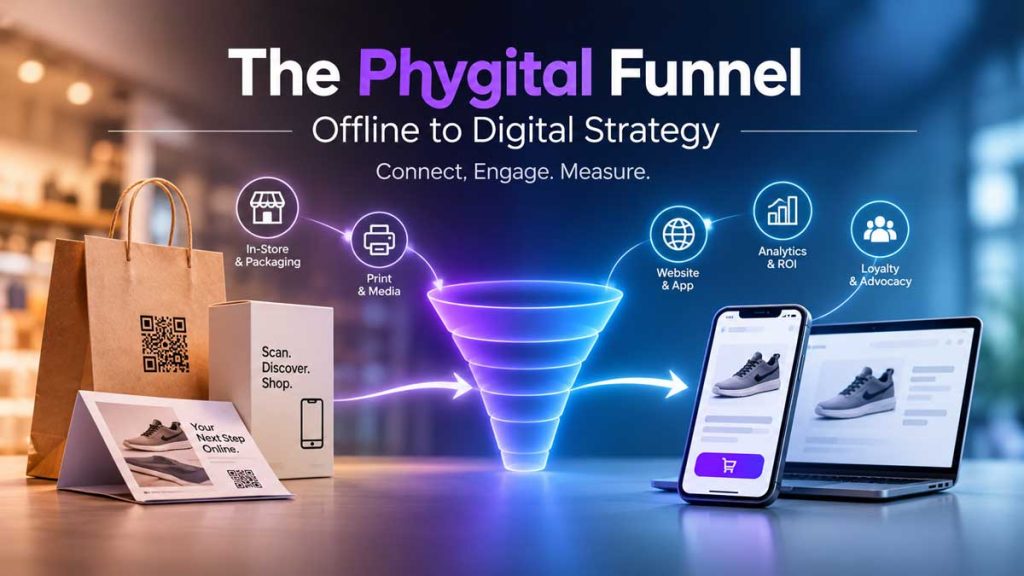
Here is a practical breakdown of how a modern phygital marketing strategy works, how attribution functions in the real world, and what technical architecture you need to build it without relying on bloated, vendor-locked software.
The Fatal Flaw of Traditional Offline Marketing
The primary reason physical marketing campaigns fail to show positive ROI is rarely the creative work; it is cognitive and mechanical friction.
Consider the traditional call-to-action on a product box or a magazine ad:
“Visit our website at brandname.com/spring-collection to claim your 15% discount.”
To act on this prompt, a prospective customer must:
- Stop what they are doing.
- Pull out their smartphone and open a mobile browser.
- Type a 35-character URL onto a tiny virtual keyboard without making a typo.
- Navigate a full desktop-first or generic mobile landing page.
In practice, more than 90% of people will not do this. Those who do will often skip typing the URL and just type your brand name into Google, meaning you end up paying pay-per-click fees to acquire a customer you had already reached through your physical collateral.
A phygital funnel eliminates this friction entirely. It turns any physical surface into an instantaneous, interactive trigger.
The Four Pillars of a Phygital Funnel
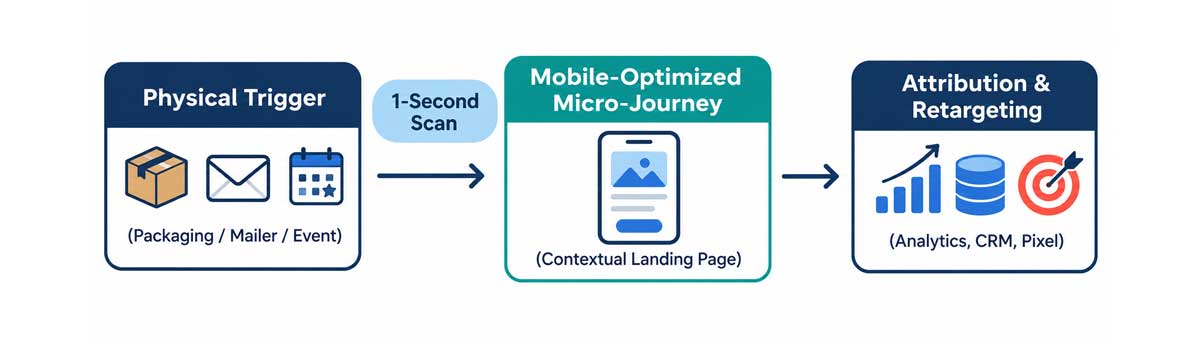
A successful offline-to-digital journey is not just about slapping a code on a piece of paper. It requires four connected components:
1. The Physical Trigger (Context & Incentive)
The trigger is your tactile touchpoint: a hangtag on an apparel line, the back of a wine bottle, a poster at a transit stop, or an unboxing insert in an e-commerce parcel.
For a physical trigger to convert, it needs clear micro-copy explaining why someone should engage right now:
- Poor: “Scan me!”
- Better: “Scan for batch origin, brewing notes, and 10% off your next bag.”
2. The Frictionless Bridge
This is the conduit that transfers the user from their physical environment to your web ecosystem. While technologies like NFC (Near Field Communication) are viable for high-end luxury goods, the universal, zero-barrier bridge remains the dynamic QR code. Every modern smartphone camera scans them natively—no dedicated app required.
3. The Contextual Landing Experience
When an offline user scans a code, they are holding a phone, usually in an active environment (a kitchen, a trade show floor, or a retail aisle). Sending them to your standard desktop homepage is a conversion killer.
The destination must be:
- Hyper-lightweight: Fast load times on spotty 4G/5G connections.
- Contextual: A direct continuation of the physical asset. If they scanned a coffee bag, show brewing instructions for that specific roast, followed by a one-click reorder button.
- Focused: Minimal navigation options, clear primary actions (e.g., wallet pass download, video play, email opt-in).
4. Digital Continuation (Attribution & Retargeting)
The scan should trigger the same analytics infrastructure you use for digital ads:
- Setting a UTM tag in Google Analytics.
- Firing a Meta or LinkedIn pixel for retargeting.
- Passing customer metadata into your CRM or email platform via a webhook.
Bringing UTM Rigor to Physical Collateral
The golden rule of digital marketing is simple: if you cannot attribute it, you cannot scale it.
In a phygital marketing strategy, every physical placement deserves its own unique tracking fingerprint. Instead of printing the same generic web address across all assets, you create distinct tracking endpoints for each medium:
| Touchpoint | Dynamic Destination URL | Tracked Insight |
| Direct Mailer A | site.com/welcome?utm_source=print&utm_medium=postcard&utm_campaign=q4_promo&utm_content=discount_a | Measures response rate for Design Variant A |
| Direct Mailer B | site.com/welcome?utm_source=print&utm_medium=postcard&utm_campaign=q4_promo&utm_content=discount_b | A/B tests conversion against Variant B |
| Product Box Insert | site.com/unboxing?utm_source=packaging&utm_medium=box_insert&utm_campaign=onboarding | Tracks post-purchase registration rates |
| Event Banner (Booth 4) | site.com/expo?utm_source=event&utm_medium=tradeshow_banner&utm_campaign=summit2026 | Gauges foot-traffic engagement at live expos |
By applying dynamic redirection behind these links, you can evaluate your print marketing budget with the exact same metrics you use for Google Search or paid social ads: cost per visit, bounce rate, and downstream conversion value.
Why “Dynamic” Routing Is Non-Negotiable
A frequent mistake made by teams experimenting with phygital flows is baking static URLs directly into printed materials.
Once an offset press prints 10,000 product boxes or direct mailers, that ink is permanent. If your static URL contains a typo, if the campaign ends, or if you decide to change your website structure six months later, those printed assets become dead ends. Even worse, if you use a “free” online generator, you risk that service inserting advertisements, tracking your users, or holding your links hostage behind unexpected subscription paywalls.
A resilient phygital strategy relies on dynamic redirection:
- The physical code points to your own web infrastructure (e.g., qr.yourdomain.com/q/summer-promo or your agency’s central portal).
- The routing engine resolves the destination on your server, forwarding the user to the active campaign page.
- If your marketing strategy changes next month, you update the target URL in your dashboard. The printed packaging in customers’ pantries continues to work seamlessly.
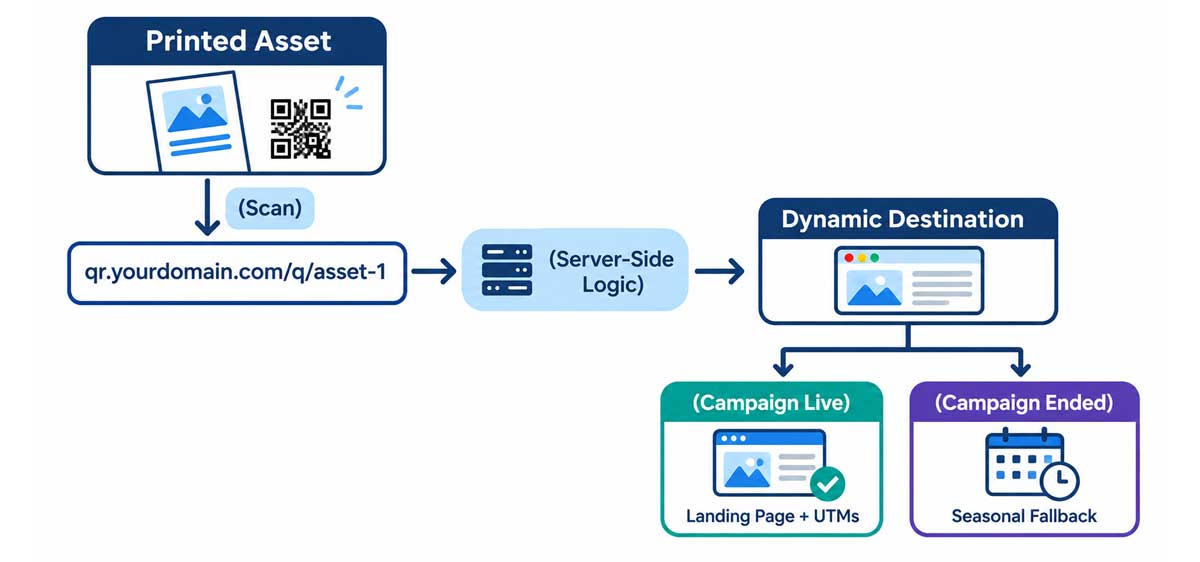
This approach allows brands and agencies to update landing destinations on the fly without ever altering the physical print.
Three Real-World Phygital Workflows
To see how this works in practice, let’s examine three practical implementations across different industries:
1. The D2C Artisan Brand (Turning Packaging into Reorders)
- The Touchpoint: A boutique skincare company places a small, tastefully styled vector code on the bottom rim of their facial serum bottle.
- The Journey: When the customer is nearly out of product, they scan the bottle. The code routes to a minimal, mobile-optimized quick-reorder screen with their favorite payment method (Apple Pay / Google Pay) pre-selected.
- The Result: The customer reorders in 15 seconds without browsing competing brands on Amazon or navigating a complex storefront.
2. High-Touch B2B Events (Eliminating Lost Business Cards)
- The Touchpoint: A software consultancy displays a clean banner at their booth with an inviting headline: “Download our 2026 Technical Benchmarking Report.”
- The Journey: Visiting enterprise leads scan the code. Instead of receiving a heavy paper booklet, they land on a fast lead-capture form that instantly fires an automated email with the PDF and prompts them to add the keynote speaker to LinkedIn.
- The Result: The sales team receives real-time notifications in Slack as leads scan at the booth, allowing for timely, personalized follow-ups.
3. The Local Restaurant or Hospitality Group (Building a First-Party List)
- The Touchpoint: A small table card near the register offering a complimentary dessert or drink on the next visit.
- The Journey: Scanning prompts the guest to join an SMS or email VIP club, delivering a digital coupon directly to their mobile wallet.
- The Result: The restaurant transforms anonymous, one-time walk-ins into a direct marketing database, reducing their dependence on third-party delivery apps and high platform commissions.
The Technical Setup: Self-Hosted Infrastructure vs. Rented Clouds
When planning your phygital infrastructure, be mindful of where your data lives and who owns your redirect endpoints.
Many SaaS providers charge $30 to $80 per month simply to maintain dynamic link redirections. For an agency managing dozens of client campaigns, or an e-commerce brand printing tens of thousands of boxes, these recurring fees accumulate rapidly—and stopping payment breaks your printed links forever.
A cleaner, more sustainable alternative is hosting your own dynamic QR routing engine:
- Host-Level Brand Control: When an agency or business installs a dynamic QR engine on its own domain (e.g., links.youragency.com), the camera preview displays the host’s domain rather than an untrusted, generic shortener. This builds immediate credibility and improves scan rates.
- Data Sovereignty: Scan counts, referrers, and device metrics remain on your own server or WordPress database, avoiding third-party data collection and simplifying GDPR compliance.
- Zero Hostage Risks: Tools like QRcdr allow you to deploy a dynamic QR engine (as a standalone PHP script or a full white-label WordPress SaaS) directly on your own hosting environment. You own the software, control the routing, and never face surprise pricing tiers or hijacked redirect paths.
(Note for agencies building client portals: running your own instance gives you centralized management over all client campaigns under your primary brand domain—a practical foundation that keeps operational overhead minimal while delivering high-value retainer services).
Key Takeaways: How to Audit Your Phygital Readiness
If you are looking to connect your physical collateral to your digital marketing stack this quarter, follow this five-step checklist:
- Map Your Physical Touchpoints: List every piece of real-world collateral you currently produce (boxes, labels, business cards, inserts, signage, fleet vehicles).
- Define One Clear Goal per Asset: Avoid generic destinations. Decide whether a touchpoint is meant to capture a lead, secure a reorder, provide post-sale documentation, or drive a review.
- Use Stable, Dynamic Redirects: Never print hardcoded campaign URLs. Always route through an engine you control so you can update destinations long after ink hits paper.
- Enforce Vector Precision: Ensure your production team exports codes in vector formats (SVG or PDF) to maintain crisp, scannable edges at any print scale.
- Tag Every Link Consistently: Apply clean UTM parameters to every physical bridge so your analytics dashboard reflects the true ROI of your real-world investments.
Physical collateral is not a relic of the pre-internet era; it is an underutilized, high-trust gateway to your digital world. With a thoughtful phygital funnel in place, your offline touchpoints stop being silent expenses and become your most predictable acquisition channels.
