



Managing a professional file exchange involves more than just storage. It requires a clear record of activity. In many collaborative environments, a “black hole” exists between the moment a file is sent and the moment it is accessed. Without a reliable Audit Trail for File Sharing, project managers often struggle to verify if clients have received critical assets or if team members have modified the correct directories.
A transparent logging system eliminates this uncertainty. It transforms a simple storage repository into a tool for professional accountability and legal compliance.
Eliminating Uncertainty with Real-Time Notifications
One of the primary friction points in client relations is the “did you get it?” follow-up email. These manual check-ins waste time and look unprofessional. A self-hosted system like Veno File Manager (VFM) solves this through automated, real-time notifications.
When you configure your SMTP settings, the system acts as a proactive assistant. You can set it to notify you the instant a client downloads a specific asset. Conversely, your clients receive immediate alerts when you upload a new deliverable. This instant feedback loop ensures that work moves forward without the need for manual status updates.
Use Case: Verifying Delivery in Legal and Financial Transactions
In industries where deadlines carry legal consequences, proof of delivery is non-negotiable. If a law firm sends a discovery document, they must know exactly when the opposing counsel accessed it.
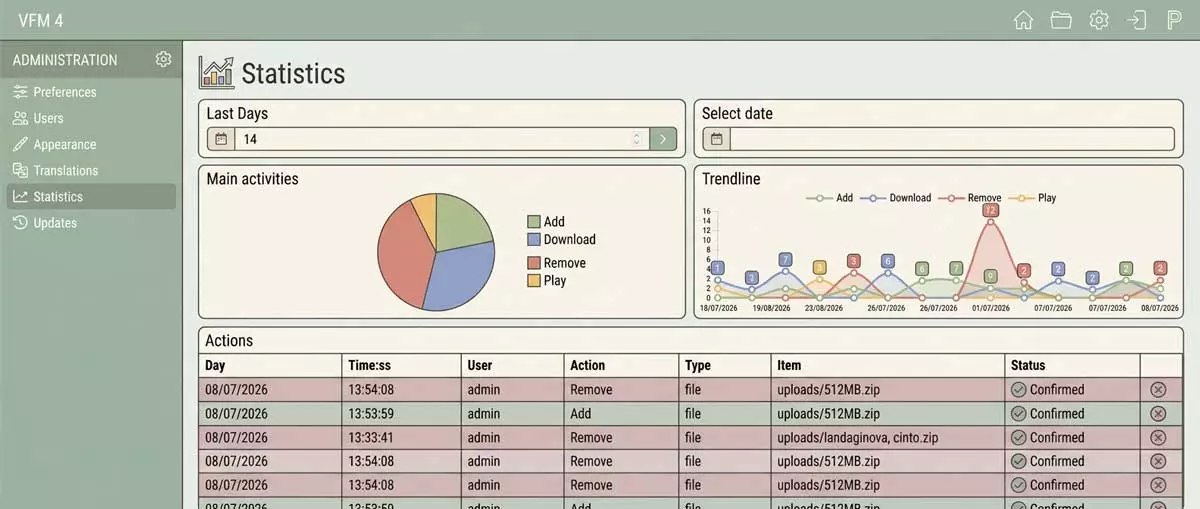
By utilizing an Audit Trail for File Sharing, the firm can view a chronological log of every interaction. This log includes:
- The username of the person who accessed the file.
- The exact timestamp (date and time).
- The IP address of the user.
- The specific action performed (upload, download, or delete).
This data serves as a definitive record. It protects the firm from claims of non-receipt and ensures that all parties remain accountable to the project timeline.
Use Case: Project Management and Resource Integrity
Internal teams often face “version confusion” when multiple editors handle the same set of files. Without a log, it is impossible to know who deleted an old folder or moved a critical sub-directory.
The VFM activity log provides total transparency for internal management. A SuperAdmin can filter logs to track the history of a specific file. This auditability prevents the loss of work. If a file is accidentally moved, the log identifies the user and the timing, allowing for a quick recovery and a professional resolution to the error.
The Technical Edge: Lightweight, Portable Logs
Many enterprise tools store logs in massive, bloated databases that are difficult to export or audit manually. VFM stays true to its flat-file philosophy by storing the Audit Trail for File Sharing in structured text and JSON files.
This approach provides three technical benefits:
- Direct Accessibility: An administrator can download the log files directly via SFTP for offline analysis or archival.
- Performance: Reading a text-based log is faster than querying a database with millions of entries, ensuring the admin panel remains responsive.
- Portability: When you back up your portal, your entire activity history is included in the file sync. You never lose your audit records during a server migration.
By implementing a robust Audit Trail for File Sharing, you remove the guesswork from your workflow. You move from a state of “hoping” the file arrived to “knowing” exactly how your data is being used.